sandywp / plugins / pods

Pods – Custom Content Types and Fields
Pods is a framework for creating, managing, and deploying customized content types and fields for any project.
Ready in seconds.
v3.3.9.2 100,000+ installs WP 6.3+ PHP 7.2+
What you get inside
6 screens-
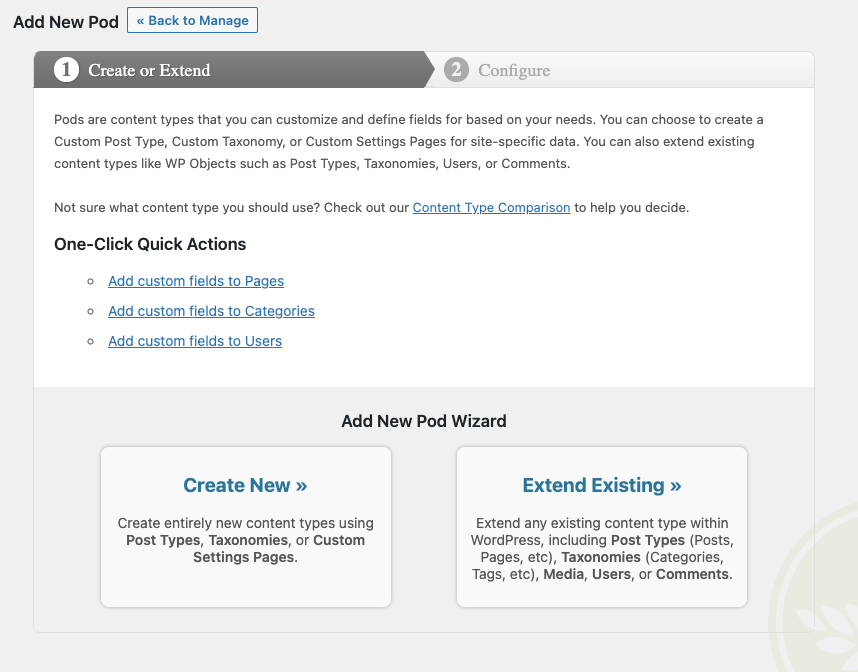
Create new content types or extend existing ones
-
Add groups of fields and manage your content type
-
Add fields of many types with individual options for each
-
Creating or extending a Post Type will add groups of fields to the Post Editor
-
Creating or extending a Taxonomy will add groups of fields to the Term Editor
-
Extending Users will add groups of fields to the User Profile and Edit forms
About this plugin
Manage all your custom content needs in one location with the Pods Framework.
- Create content types including Custom Post Types, Custom Taxonomies, and our special Advanced Content Types (ACTs get their own custom tables)
- Extend and customize content types including Posts, Pages, Categories, Tags, Users, and Media with one easy click
- Create custom settings pages easily within seconds
- Add custom fields to any content type
- Conditionally show fields based on the value of other fields with Conditional Logic
- Group your fields however you’d like into their own sections and add additional headings to help organize
- Show your fields anywhere using our blocks, shortcodes, widgets, or the non-coder Pods Template approach along with our automatic theme integration
- Create connections between any of your content with relationship fields to keep your content organized
Let Pods help you grow your development and site building skills so that you can manage content beyond the standard WordPress Posts & Pages.
Want to check it out? Give Pods a test drive with our new One-click Demo.
Check out our Documentation, Support Forums, and our Live Community Slack Chat for assistance building your dream project with Pods.
Introduction
Content types that evolve with your needs
Create any type of content that you want — small or large — we’ve got you covered. Every content type created with Pods gets all the love it needs to grow up big and strong. You’ll get an easy-to-use interface that lets you manage field groups, custom fields, and how your content type will look or function.
Create new content types
With Pods, you can create entirely new content types and settings pages.
Every Field Type, FREE
If you choose to use Pods for your custom fields, you’ll get every field type you need, free of charge. Pods works great alongside other custom field plugins like Advanced Custom Fields too.
We have an extensive collection of over 25 different input types to choose from on 20+ different field types for any content structure. Each field type comes with their own additional options to help you customize content entry and display.
You can also control visibility by role/capability and other advanced options.
- Repeatable Fields: Turn almost any field into a repeatable field with multiple values
- Text: Plain Text, Website, Phone, Email, Password
- Paragraph: Plain Paragraph Text, WYSIWYG (Visual Editor), Code (Syntax Highlighting)
- Date / Time: Date and Time, Date, Time
- Number: Plain Number, Currency (30+ international currencies)
- Relationships / Media: File / Image / Video (Media library and basic upload options available), Avatar (for extended Users), oEmbed, Relationship (Dropdown, Multi Select, Autocomplete, Checkboxes, Radio Buttons, and List View available)
- Checkbox (Yes / No)
- Color Picker
- Layout Fields: Heading text, HTML content
Relationships to rule the world with
The power is in your hands with our comprehensive support to relate your content to anything.
- Custom defined lists of text options
- Relate to any Post Type or Taxonomy posts / terms
- Relate to any User profile
- Relate to User Roles or Capabilities
- Relate to any Comment
And many other relationships are also available including:
- Image Sizes
- Navigation Menus
- Relate to content within any Database Table
- Countries (predefined)
- US States (predefined)
- Canadian Provinces (predefined)
- Calendar – Days of Week (predefined)
- Calendar – Months of Year (predefined)
- And many more!
Optional Components to do even more
You can enable some of our included components to extend your WordPress site even further:
- Types-only Mode – On our Pods Settings page, you can choose to disable creating custom fields for a performance boost if you only want to use Pods for content types or you plan on using it alongside of other custom field plugins
- Pods Templates – Use our template engine to create templates that can be handed off to clients for care-free management
- Markdown Syntax – Parses Markdown Syntax for Paragraph Text / WYSIWYG fields
- Advanced Relationships – Add even more relationship objects including Database Tables, Multisite Networks, Multisite Sites, Themes, Page Templates (in the theme), Sidebars, Post Type Objects, and Taxonomy Objects
- Table Storage – Enable table-based database storage for custom fields on Post Types, Media, Users, and Comments
- Roles and Capabilities – Create or edit Roles for your site and customize what they have access to
- Advanced Content Types – Create entirely custom content types that have their own database table, and they will exist outside the normal WordPress context avoiding meta database tables
- Pods Pages – Create custom pages that function off of your site’s URL path with wildcard support and choose the Page Template in the theme to use — most useful paired with Advanced Content Types
Plugins that integrate with Pods
- Advanced Views Lite – Lets you build templates (views) and queries (cards) so that you can manage your content rendering with less code. (Disclaimer: We have an affiliate link to them to help support our project)
- Bricks Builder
- Codepress Admin Columns using premium Admin Columns Pro Pods integration
- Conductor
- Elementor Pro
- Polylang has direct integration in Pods itself
- Timber
- WPGraphQL has direct integration in Pods itself
- WPML has direct integration in Pods itself
- YARPP has direct integration in Pods itself
Themes that integrate with Pods
- Genesis (StudioPress) has direct integration in Pods itself
Extend Pods with Free Add-Ons
- Pods Beaver Themer Add-On – Integrates Pods with Beaver Themer
- Pods Gravity Forms Add-On – Integrates Pods with Gravity Forms
- Pods Alternative Cache Add-On – Speed up Pods on servers with limited object caching capabilities
- Pods SEO Add-On – Integrates Pods Advanced Content Types with Yoast SEO
- Pods AJAX Views Add-On – Adds new functions you can use to output template parts that load via AJAX after other page elements
Extend Pods with Free Third-party Add-Ons
- Paid Memberships Pro – Pods Add On – Integrates Pods with Paid Memberships Pro to extend PMPro objects with custom fields added by Pods
- Panda Pods Repeater Field Add-On – Lets you add groups of fields that repeat and are stored in their own custom database table (Advanced setup required)
Pods Pro by SKCDEV Premium Add-Ons
- List Tables Add-On – A new block and shortcode to list/filter content from Pods in a table format
- Page Builder Toolkit Add-On – Integrates Pods with Beaver Builder, Beaver Themer, Conditional Blocks Pro, Divi Theme, Elementor, GenerateBlocks, Oxygen Builder, and Stackable Blocks (premium)
- Advanced Relationships Storage Add-On – Advanced options for relationship storage
- TablePress Integration Add-On – Integrates Pods with TablePress
- Advanced Permalinks Add-On – Advanced permalink structures and taxonomy landing pages
How can I translate Pods into my own language?
Many thanks go out to the fine folks who have helped us translate the Pods plugin into many other languages.
Join us in further translating the Pods interface on the official Translating WordPress dashboard
We are also available through our Live Community Slack Chat to help our translators get started and to support them on the process.
Are you looking to translate your Pods and Fields themselves? You’ll want to enable the “Translate Pods” component from Pods Admin > Components.
Contributors
Pods really wouldn’t be where it is without all the contributions from our donors and code/support contributors.
Questions
- Where do I go for Support on your plugin?
Our primary Support is handled through our Support Forums. For the fastest support, you can contact us on our Live Community Slack Chat in the #support channel. We do not staff our Slack channel 24/7, but we do check any questions that come through daily and reply to any unanswered questions.
We do have a community of Pods users and developers that hang out on Slack, so you’re sure to get an answer quickly. We answer our Forum questions once a week with follow-up during the week as we’re prioritizing resources towards restructuring and improving our documentation.
- Where do I report bugs or request features?
If you’ve encountered a bug or have an idea for a new feature, we kindly request you to create an Issue on our GitHub Repository at https://github.com/pods-framework/pods/issues/new. Please be very specific about what steps you did to create the issue you’re having and include any screenshots or other configuration parameters to help us recreate or isolate the issue.
- Will Pods work with my Theme?
Most likely the answer is yes. We don’t require any special CSS or display attributes to use Pods with your theme, so you should have little to no difficulty showing your content in your theme. If you encounter any issues, contact your theme developer and ask them about their support for the standard WordPress theming functions and how to use WordPress Template Hierarchy with their theme.
sandywp / also on the shelf
Try another plugin

4.6 · 1M+ installs
Admin UI for creating custom content types like post types and taxonomies

3.7 · 20K+ installs
Essential Content Types allows you to feature the impressive content through different content/post types on your website just…
5.0 · 30+ installs
A developer tool displaying all registered post types w/ the benefit of exposing CPT's to AI tools and admin clients via the…
Spin up a real WordPress site in seconds.
Test plugins, build a demo, hand a client a link — then squash it and start again. No local setup, no Docker.