sandywp / plugins / two-factor

Two Factor
Enable Two-Factor Authentication (2FA) using time-based one-time passwords (TOTP), email, and backup verification codes.
Ready in seconds.
v0.16.0 100,000+ installs WP 6.8+ PHP 7.2+
What you get inside
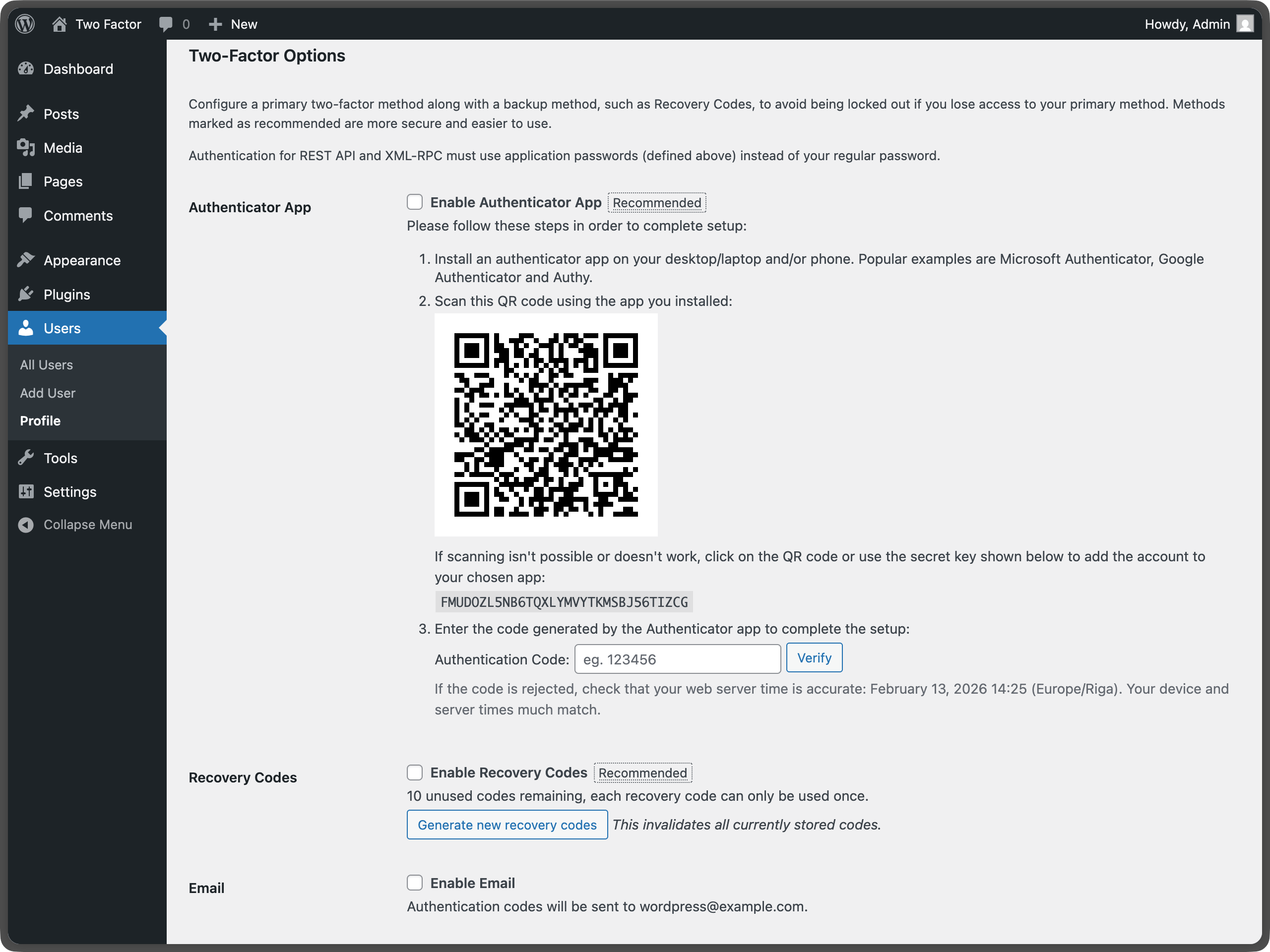
4 screens-
Two-factor options under User Profile - Shows the main configuration area where users can enable different authentication methods.
-
Email Code Authentication during WordPress Login - Shows the email verification screen that appears during login.
-
Authenticator App (TOTP) setup with QR code - Demonstrates the QR code generation and manual key entry for TOTP setup.
-
Backup codes generation and management - Shows the backup codes interface for generating and managing emergency access codes.
About this plugin
The Two-Factor plugin adds an extra layer of security to your WordPress login by requiring users to provide a second form of authentication in addition to their password. This helps protect against unauthorized access even if passwords are compromised.
Setup Instructions
Important: Each user must individually configure their two-factor authentication settings.
For Individual Users
- Navigate to your profile: Go to “Users” → “Your Profile” in the WordPress admin
- Find Two-Factor Options: Scroll down to the “Two-Factor Options” section
- Choose your methods: Enable one or more authentication providers (noting a site admin may have hidden one or more so what is available could vary):
- Authenticator App (TOTP) – Use apps like Google Authenticator, Authy, or 1Password
- Email Codes – Receive one-time codes via email
- Backup Codes – Generate one-time backup codes for emergencies
- Dummy Method – For testing purposes only (requires WP_DEBUG)
- Configure each method: Follow the setup instructions for each enabled provider
- Set primary method: Choose which method to use as your default authentication
- Save changes: Click “Update Profile” to save your settings
For Site Administrators
- Plugin settings: The plugin provides a settings page under “Settings → Two-Factor” to configure which providers should be disabled site-wide.
- User management: Administrators can configure 2FA for other users by editing their profiles
- Security recommendations: Encourage users to enable backup methods to prevent account lockouts
Available Authentication Methods
Authenticator App (TOTP) – Recommended
- Security: High – Time-based one-time passwords
- Setup: Scan QR code with authenticator app
- Compatibility: Works with Google Authenticator, Authy, 1Password, and other TOTP apps
- Best for: Most users, provides excellent security with good usability
Backup Codes – Recommended
- Security: Medium – One-time use codes
- Setup: Generate 10 backup codes for emergency access
- Compatibility: Works everywhere, no special hardware needed
- Best for: Emergency access when other methods are unavailable
Email Codes
- Security: Medium – One-time codes sent via email
- Setup: Automatic – uses your WordPress email address
- Compatibility: Works with any email-capable device
- Best for: Users who prefer email-based authentication
FIDO U2F Security Keys
- Deprecated and removed due to loss of browser support.
Dummy Method
- Security: None – Always succeeds
- Setup: Only available when WP_DEBUG is enabled
- Purpose: Testing and development only
- Best for: Developers testing the plugin
Important Notes
HTTPS Requirement
- All methods work on both HTTP and HTTPS sites
Browser Compatibility
- TOTP and email methods work on all devices and browsers
Account Recovery
- Always enable backup codes to prevent being locked out of your account
- If you lose access to all authentication methods, contact your site administrator
Security Best Practices
- Use multiple authentication methods when possible
- Keep backup codes in a secure location
- Regularly review and update your authentication settings
For more information about two-factor authentication in WordPress, see the WordPress Advanced Administration Security Guide.
For more history, see this post.
Actions & Filters
Here is a list of action and filter hooks provided by the plugin:
two_factor_providersfilter overrides the available two-factor providers such as email and time-based one-time passwords. Array values are PHP classnames of the two-factor providers.two_factor_providers_for_userfilter overrides the available two-factor providers for a specific user. Array values are instances of provider classes and the user objectWP_Useris available as the second argument.two_factor_enabled_providers_for_userfilter overrides the list of two-factor providers enabled for a user. First argument is an array of enabled provider classnames as values, the second argument is the user ID.two_factor_user_authenticatedaction which receives the logged inWP_Userobject as the first argument for determining the logged in user right after the authentication workflow.two_factor_user_api_login_enablefilter restricts authentication for REST API and XML-RPC to application passwords only. Provides the user ID as the second argument.two_factor_email_token_ttlfilter overrides the time interval in seconds that an email token is considered after generation. Accepts the time in seconds as the first argument and the ID of theWP_Userobject being authenticated.two_factor_email_token_lengthfilter overrides the default 8 character count for email tokens.two_factor_backup_code_lengthfilter overrides the default 8 character count for backup codes. Provides theWP_Userof the associated user as the second argument.two_factor_rest_api_can_edit_userfilter overrides whether a user’s Two-Factor settings can be edited via the REST API. First argument is the current$can_editboolean, the second argument is the user ID.two_factor_before_authentication_promptaction which receives the provider object and fires prior to the prompt shown on the authentication input form.two_factor_after_authentication_promptaction which receives the provider object and fires after the prompt shown on the authentication input form.two_factor_after_authentication_inputaction which receives the provider object and fires after the input shown on the authentication input form (if form contains no input, action fires immediately aftertwo_factor_after_authentication_prompt).two_factor_login_backup_linksfilters the backup links displayed on the two-factor login form.
Redirect After the Two-Factor Challenge
To redirect users to a specific URL after completing the two-factor challenge, use WordPress Core built-in login_redirect filter. The filter works the same way as in a standard WordPress login flow:
add_filter( 'login_redirect', function( $redirect_to, $requested_redirect_to, $user ) {
    return home_url( '/dashboard/' );
}, 10, 3 );
Questions
- What PHP and WordPress versions does the Two-Factor plugin support?
This plugin supports the last two major versions of WordPress and the minimum PHP version supported by those WordPress versions.
- How can I send feedback or get help with a bug?
The best place to report bugs, feature suggestions, or any other (non-security) feedback is at the Two Factor GitHub issues page. Before submitting a new issue, please search the existing issues to check if someone else has reported the same feedback.
- Where can I report security bugs?
The plugin contributors and WordPress community take security bugs seriously. We appreciate your efforts to responsibly disclose your findings, and will make every effort to acknowledge your contributions.
To report a security issue, please visit the WordPress HackerOne program.
- What if I lose access to all my authentication methods?
If you have backup codes enabled, you can use one of those to regain access. If you don’t have backup codes or have used them all, you’ll need to contact your site administrator to reset your account. This is why it’s important to always enable backup codes and keep them in a secure location.
- Can I use this plugin with WebAuthn?
The plugin previously supported FIDO U2F, which was a predecessor to WebAuthn. There is an open issue to add WebAuthn support here: https://github.com/WordPress/two-factor/pull/427
- Is there a recommended way to use passkeys or hardware security keys with Two-Factor?
Yes. For passkeys and hardware security keys, you can install the Two-Factor Provider: WebAuthn plugin: https://wordpress.org/plugins/two-factor-provider-webauthn/
. It integrates directly with Two-Factor and adds WebAuthn-based authentication as an additional two-factor option for users.
sandywp / also on the shelf
Try another plugin

Wordfence Security – Firewall, Malware Scan, and Login Security
4.7 · 5M+ installs
Firewall, Malware Scanner, Two Factor Auth, and Comprehensive Security Features, powered by our 24-hour team. Make security a…
-
Easily improve site security with WordPress Hardening, Two-Factor Authentication (2FA), Login Protection, Vulnerability Detection…

Limit Login Attempts Security – Login Security, 2FA, Firewall, Brute Force…
4.8 · 1M+ installs
WordPress login security with brute force protection, Two-factor authentication (2FA/MFA), firewall, IP/country blocking, and…

Spin up a real WordPress site in seconds.
Test plugins, build a demo, hand a client a link — then squash it and start again. No local setup, no Docker.