sandywp / plugins / replai-favicon

Replai Favicon
Favicon & App Icons for Every Device
Generate a complete favicon set for every browser and device from one image. Generated on your own site, no external service.
Ready in seconds.
v1.0.12 WP 6.2+ PHP 7.2+
What you get inside
2 screens-
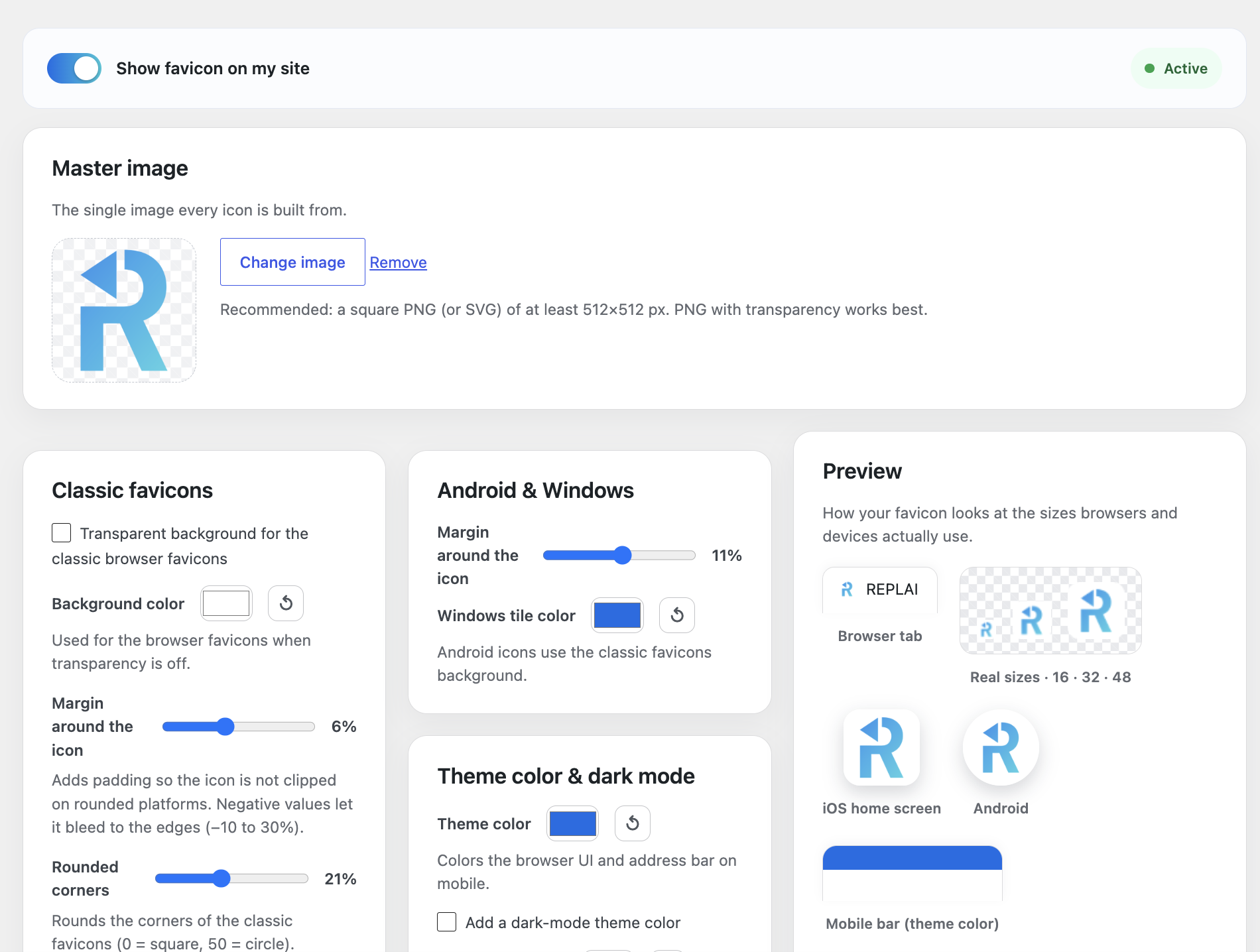
The settings screen: master image, classic favicons (transparency, background, per-type padding and rounded corners), Android/Windows and theme color — next to…
-
Apple Touch, app name and advanced options (replace the WordPress Site Icon tags, serve /favicon.ico from the site root), the sticky real-time preview, and the…
About this plugin
Replai Favicon turns a single master image into every icon your site needs — and adds the right HTML automatically. No copy-paste, no third-party service: everything is generated on your own server.
From one image the plugin creates:
- favicon.ico (16/32/48) — the classic icon, still used by browsers on PDF pages and elsewhere.
- PNG favicons — 16, 32, 48 and 96 px for crisp browser tabs and Google search results.
- Apple Touch icon (180×180) — the iOS home-screen icon, always with a solid background.
- Android icons + web app manifest — 192 and 512 px plus a maskable icon and a
site.webmanifest. - Windows tiles — an
mstile-150x150.pngand abrowserconfig.xml. - SVG favicon — if your master image is an SVG, it is served as a modern vector favicon too.
Many options
- Transparent or solid background for the classic favicons, with a color picker and a one-click reset to white.
- Padding per icon type — set a different margin for browser favicons, Apple Touch and Android, and even go slightly negative so the icon bleeds to the edges.
- Rounded corners for the classic favicons, from square all the way to a circle.
- Apple Touch background (iOS icons are always opaque).
- Theme color for the mobile browser UI, plus a Windows tile color.
- Dark mode — an optional alternative
theme-colorforprefers-color-scheme: dark. - App name for the web app manifest (defaults to your site title).
Smart and safe
- Real-time preview — a sticky preview panel shows your icon in a browser tab, at real sizes, on iOS and on Android, and updates live as you change any option, before you generate.
- Replaces the WordPress Site Icon tags (optional) so you never get duplicate icon markup.
- Serves /favicon.ico from the site root (optional) for browsers and crawlers that request it directly.
- Turn it on or off without regenerating — the files are kept.
The whole admin is available in 7 languages (English, Spanish, Catalan, French, Italian, Portuguese and German) based on your site language.
Everything runs on your own site. Icons are generated locally with GD or Imagick — your image is never uploaded to an external service.
Questions
- What image should I use?
A square image, at least 512×512 px. A PNG with transparency works best; SVG is also supported and served as a modern vector favicon.
- Does it call any external service?
No. All icons are generated on your own server with GD or Imagick. Your image never leaves your site.
- My server has no GD or Imagick. What happens?
The plugin shows a notice. Ask your host to enable the GD extension (available on almost all hosting) and generate again.
- Will it clash with a Site Icon set in the Customizer?
No. By default Replai Favicon replaces the WordPress Site Icon tags so there are no duplicate icons. You can turn this off.
- Does /favicon.ico work at the site root?
Yes, optionally. When enabled, requests to
/favicon.icoare redirected to the generated icon, which helps browsers and crawlers that request it directly (for example on PDF pages).- Can I change the icon later?
Yes. Pick a new master image or change any option and press Regenerate. A cache-busting version is added automatically so browsers pick up the new icon.
Spin up a real WordPress site in seconds.
Test plugins, build a demo, hand a client a link — then squash it and start again. No local setup, no Docker.